Hotel Mapping, Reimagined as Infrastructure
By Mapping Engineering
Today, mapping is live. As of August 10, 2026, any travel company can resolve any property to a single unified ID across all of its suppliers, for free. This is the launch of the identity layer for travel inventory, and this post explains what hotel mapping is, why it has been a quiet drain on the industry, and how mapping approaches it differently.
The hotel mapping problem
The same hotel can exist under thousands of different IDs. Every distributor, wholesaler, bedbank, and channel uses its own identifier, and there is no shared standard connecting them. A property called "Grand Astoria Hotel" in one feed and "Astoria Grand" in another is the same building, but nothing in the data says so.
That fragmentation is expensive. It produces duplicate listings in search, rates compared against the wrong room, and hours of manual reconciliation for supply and data teams. Most companies end up building their own hotel mapping layer to cope: fuzzy name matching, geo-radius checks, and a growing pile of edge-case rules that break every time a new supplier is added. It is a project that never really ends, and it belongs to no one.
What is hotel mapping?
Hotel mapping is the process of matching records that describe the same physical property across different data sources and assigning them a shared identity. Done well, it lets you deduplicate inventory, join rates and availability from multiple suppliers for the same hotel, and reconcile your own catalog against every new feed you add.
The hard part is not finding a match. It is knowing whether a match is correct. Names are inconsistent, addresses are formatted a dozen ways, and coordinates drift. A hotel mapping solution is only as useful as its ability to tell you how confident it is.
Introducing mapping: the identity layer for travel inventory
mapping resolves any property to one unified ID across all your suppliers. Hotels, serviced apartments, hostels, and vacation rentals are all handled the same way. Every match comes back with a confidence score, so you decide what to auto-accept and what to route for review. Nothing enters your inventory as a silent guess.
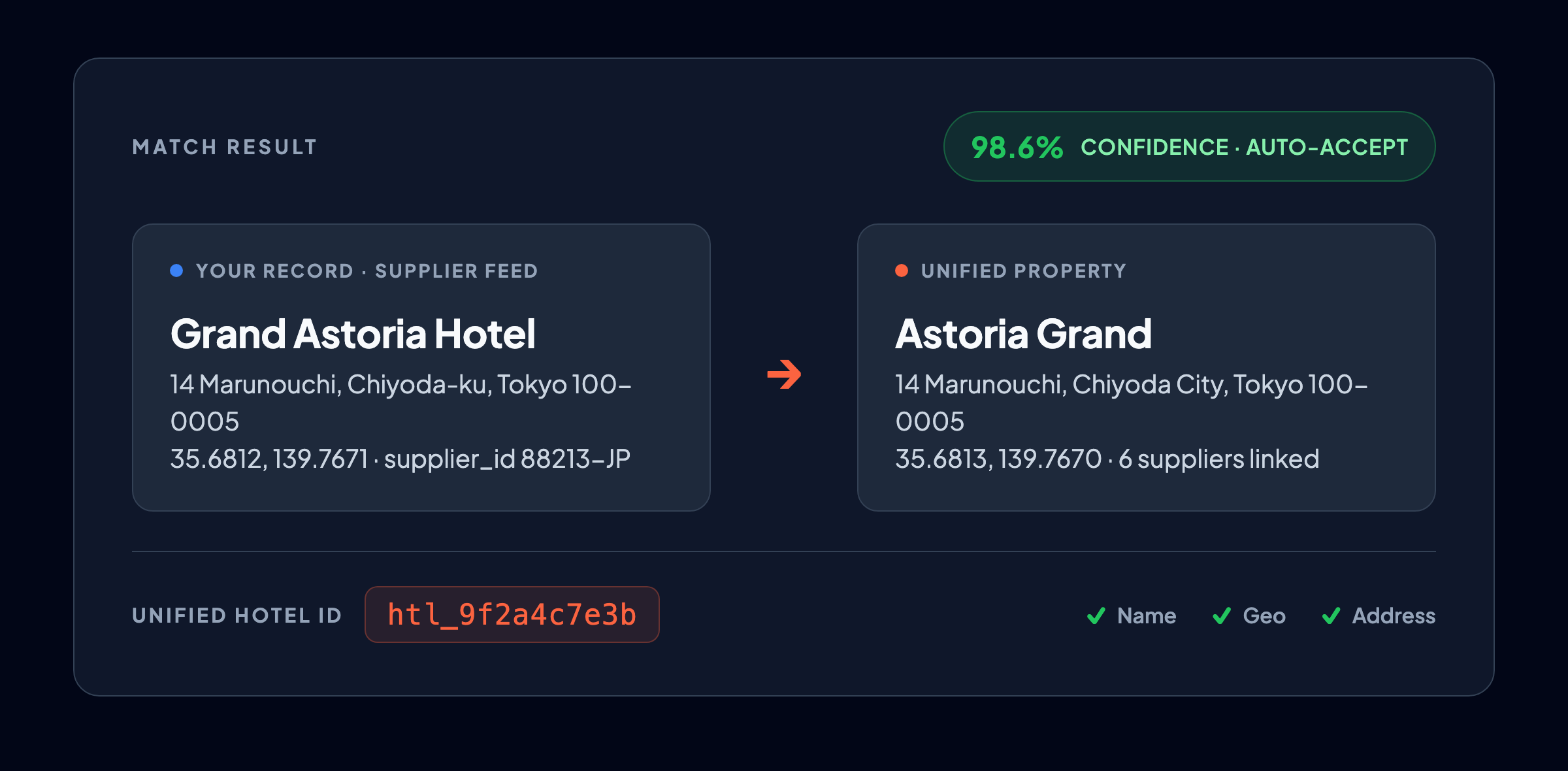
We built mapping to be the layer you plug in, not the one you maintain forever. There is no data pipeline to stand up on your side and no model to train. You integrate over a simple hotel mapping API, or through our MCP server if you are wiring it into an agent or assistant, and you are resolving properties in minutes rather than a quarter.
Why a modern hotel mapping API matters
Most existing hotel mapping tools share the same weaknesses. Matches arrive as a plain yes or no with no confidence attached, so silent errors slip into your catalog. Coverage gaps force manual cleanup. And access is often priced as enterprise-only, which puts reliable mapping out of reach for smaller teams.
mapping takes the opposite position on each. Confidence scores on every match. Continuous coverage across the sources the industry runs on. And free to start, because we believe the identity layer for travel inventory should be shared infrastructure, not a moat rented back to the industry.
What you can do with mapping
- Deduplicate inventory so each property appears once, not five times.
- Join rates and availability from different suppliers for the same hotel.
- Reconcile your catalog against every new feed you onboard.
- Compare like for like across sources, and prioritise the best rate or margin.
- Trust your data with a confidence score behind every unified hotel ID.
Free to start
mapping is free to start and simple to adopt, then scales with usage. You can benchmark it against whatever you use today, on your own inventory, without a project or a commitment. If the results are better, you keep going. If not, you have lost nothing but a few minutes.
Frequently asked questions
More answers are on our FAQ page.
What is a unified hotel ID?
A unified hotel ID is a single identifier that represents one physical property across every supplier and feed, replacing the many different IDs each source assigns to the same hotel.
How is mapping different from building hotel mapping ourselves?
Building it yourself means maintaining fuzzy matching, geo checks, and endless edge-case rules that break as suppliers change. mapping is that layer, built once and maintained for you, behind a single API.
What types of properties can mapping handle?
All accommodation types: hotels, serviced apartments, hostels, and vacation rentals are resolved to one unified ID the same way.
Is mapping really free?
Yes. mapping is free to start, with paid plans for higher volume and production workloads. Full pricing is available at launch.
How long does it take to integrate the hotel mapping API?
Minutes, not a quarter. It is a single call and response with no infrastructure to stand up on your side, so most teams resolve their first properties the same day.
Get started
mapping is live as of August 10, 2026. Resolve your first properties today and see what one unified ID across all your suppliers does for your inventory.